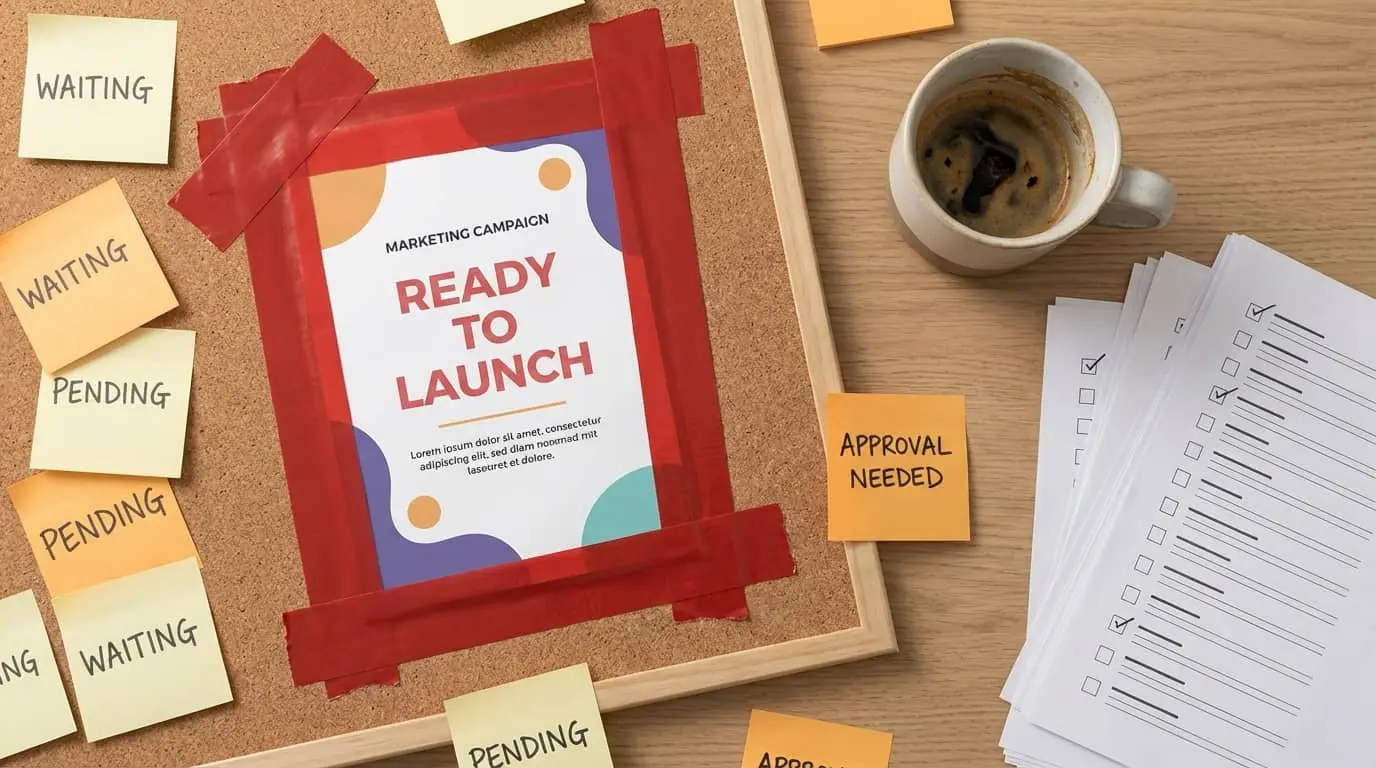
65% of marketers lose a full day every week chasing approvals. Only 6% use AI to fix this—the rest are stuck in email chains and revision loops. Here's how to escape approval purgatory and ship more campaigns.

Who this is for
Marketing directors who are tired of watching campaigns die in review cycles. You know the feeling. A launch that should take days stretches into weeks. Creative energy gets killed by feedback loops that never end.
If you've missed a launch window because of "one more revision," keep reading.
The problem
Your campaigns are stuck. The work is good. But getting approval takes forever.
Every stakeholder has opinions. Every revision spawns three more emails. By the time you get sign-off, the moment has passed.
Your competitors are shipping faster. And you can't figure out how.
How much do slow approvals actually cost your team?
More than you think. According to a Ziflow survey, 65% of marketers lose over a day each week just chasing feedback. That's a full day spent waiting and following up instead of doing actual work.
Multiply that across your team. Five people losing a day per week adds up to 260 lost days per year. That's an entire person-year of productivity gone.
The damage goes beyond time:
- Campaigns that arrive late miss their moment
- Content goes stale while sitting in someone's inbox
- Your team burns out from revision loops that feel pointless
- You fall behind competitors who can actually ship on time
A study by Kapost and Gleanster found that 92% of marketers cite approval delays as the top reason they miss deadlines. Not creative blocks. Not resource constraints. Just approvals.
Why do traditional approval workflows break down?
Most approval processes weren't designed. They evolved. Someone added a stakeholder here, a review step there. Before you knew it, you had a 15-person approval chain with no clear owner.
Here's what typically goes wrong.
What happens when too many stakeholders own the process?
Nobody knows who has final say. Content gets routed to legal, compliance, brand, product, sales, and local markets. Each group has their own timeline.
Why do email-based approvals lose context?
Because feedback gets scattered across threads. Version 3 is in one thread. The legal feedback is in another. Someone replied to the wrong email. Now you're piecing together feedback from six different places.
How does version control break down during approvals?
Nobody knows which file is current. Is it in the email? The shared drive? The one Sarah just Slacked? You waste half your time just figuring out what to review.
Why do compliance reviews become bottlenecks?
Because they lack clear criteria and fast turnaround times. Legal and brand reviews are necessary. But without structure, they become black holes where campaigns disappear.
What does AI workflow automation actually do?
AI workflow automation is the use of artificial intelligence to route, track, and accelerate business processes — like marketing approvals — without manual follow-ups or email chains.
It removes the busywork around human judgment. Here's the gap: only 6% of marketers have fully embedded AI into their workflows. The other 94% are still stuck in email chains.
That's your advantage, if you move now.
AI workflow automation doesn't replace human judgment. It removes the friction around it. (If you're still deciding whether automation is right for your team, start with how AI automation helps growing businesses compete.)
How does AI auto-route content to the right approvers?
Content goes to the right person automatically based on type, campaign, or brand. No more chasing down who needs to see what.
How does AI pre-check content before human review?
AI catches the obvious mistakes first. It flags brand guideline violations, missing disclaimers, or compliance issues before a human ever sees the content. Fewer revision cycles for easy fixes.
How does automated deadline tracking work?
The system escalates automatically when someone misses their review window. No more awkward "just following up" emails.
How does status visibility reduce approval delays?
Stakeholders check status themselves instead of asking you. Dashboards show exactly where content sits in the pipeline.
See where your approval bottlenecks are hiding.
Get Your Free Automation MapWhat results does AI workflow automation actually deliver?
Early adopters are saving days every week. Nucleus Research found that companies earn $5.44 for every $1 spent on marketing automation. Here's what the numbers look like in practice:
- 80% increase in lead volume with automated nurturing
- 77% higher conversion rates from automated scoring and follow-up
- 25–30% reduction in operational marketing costs
- 34% average revenue boost attributed to marketing automation
That changes what your week looks like. When your team stops chasing approvals and following up manually, they run more campaigns and produce better creative. Strategy replaces project management.
How do you start automating approvals without replacing everything?
Start small and prove it works. You don't need to overhaul your entire operation.
Step 1: Where do your campaigns actually stall?
Map your current process before buying anything. Where do campaigns stall? Who holds things up? What steps add no value?
Talk to your team. They know exactly where the time goes.
Step 2: Which campaign type should you pilot first?
Pick one repeatable campaign you do regularly. Don't try to automate everything at once. Choose social posts, email newsletters, or blog content — something with a predictable approval path.
Step 3: How do you connect your existing tools?
You probably don't need new software — you need your current tools talking to each other. Modern automation platforms connect what you already use. Project management, design tools, communication apps — all working together.
If the handoffs live across several tools, AI automation is the work of connecting them into one trackable process.
Step 4: How do you measure the improvement?
Track specific numbers before and after:
- Time from draft to published
- Number of revision cycles
- Hours spent on approval-related tasks
- Campaigns shipped per month
Real data beats assumptions. It also helps justify expanding to other workflows. (For a broader look at picking the right approach, see why strategy matters more than tools.)
Key takeaways
- Approval bottlenecks cost more than you think. 65% of marketers lose a day per week to them.
- Only 6% of marketers have fully embedded AI into their workflows. That leaves room for you.
- The right setup can cut approval time by 80%+
- Start with one workflow, prove it works, then expand
- The goal is shipping more, not adding more tools
Frequently asked questions
Quick answers to common questions
Ready to escape approval purgatory?
The difference between teams that ship and teams that stall comes down to process, not talent. If your campaigns keep dying in review cycles, you don't need to work harder. You need a better system.
Book a free automation assessment to find out where your biggest approval bottlenecks are hiding and how to eliminate them without replacing your entire stack.