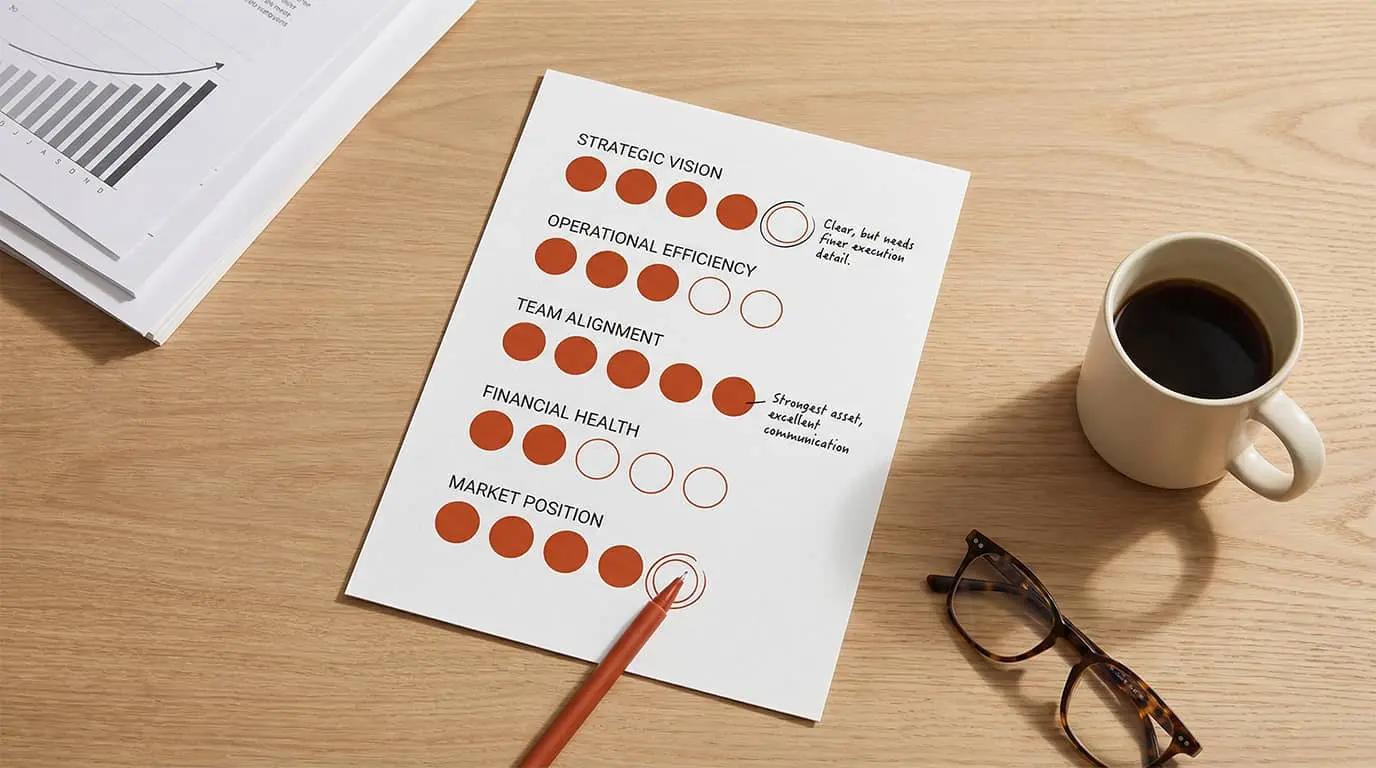
Before investing in AI, assess your readiness across five critical dimensions. This framework helps you identify gaps and prioritize preparation.

Who this is for
You're thinking about AI for your business but aren't sure you're ready. Maybe you've seen competitors adopt it. Or a vendor pitched you on a tool that sounded promising. This framework gives you an honest answer — not "should we do AI?" but "what do we need to fix first?"
The problem
Most AI projects fail before they start. Not because the technology was wrong, but because the business wasn't ready. Teams rush into buying tools without the foundations in place. Then they blame the tools when nothing works.
Here's what we see over and over. A company spends $15K on an AI platform, realizes their data is in six disconnected spreadsheets, and shelves the whole thing in three months.
Readiness is fixable. You just need to know where the gaps are.
What are the five dimensions of AI readiness?
AI readiness is your business's ability to adopt and benefit from artificial intelligence — measured across data, processes, team capacity, technology, and leadership alignment.
Rate yourself 1–5 on each dimension. Be honest — a low score isn't bad news. It's a to-do list.
Is your data ready for AI?
AI runs on clean, accessible, consistent data. If your team spends hours copying data between systems or hunting for the "right" spreadsheet, that's your first red flag.
If the data is usable but the handoffs are still manual, AI automation is usually the next practical step.
Ask yourself:
- Where does your critical business data actually live? One system or seven?
- Can you pull a report on last quarter's revenue in under five minutes?
- How many hours a week does your team spend on manual data entry?
- When did someone last clean up your contact list or CRM?
We worked with an agency that had client info in five places — a CRM, three spreadsheets, and email threads. When they tried to automate reporting, the AI tool had nothing consistent to pull from. Two months of cleanup before they could even start.
Compare that to a landscaping company that ran everything through one system. Customer history, job notes, invoices — all connected. Their scheduling automation worked on day one.
Scoring: 1–2 means major data work ahead. 3 means functional but scattered. 4–5 means you're in good shape.
Are your business processes documented and repeatable?
You can't automate chaos. If three people on your team handle the same task three different ways, AI has nothing repeatable to work with.
Think about:
- Are your core workflows written down anywhere?
- Would a new hire know exactly how to handle a customer inquiry on day one?
- Can you draw out the steps in your key processes from start to finish?
- Where do things fall through the cracks during handoffs?
A property management firm had three people fielding tenant inquiries. One used email templates. One typed every response from scratch. One did a mix. When they brought in an AI assistant, it couldn't learn a process that didn't exist yet.
A dental practice had it figured out. Every new patient followed the same intake steps, documented and consistent. They added AI scheduling in two weeks. The property management firm? Two months, and most of that was standardizing how they worked before AI could help.
Does your team have bandwidth to adopt AI?
This one catches people off guard. Your team needs bandwidth to learn new tools. If they're already stretched thin, that bandwidth doesn't exist.
Consider:
- Is your team buried right now, or do they have room for something new?
- Who on your team would actually get excited about this?
- What's the general attitude toward change? Curious or skeptical?
- Where will you hit resistance?
An accounting firm rolled out an AI tool during tax season. Nobody had time to learn it. The software sat untouched for four months. When they relaunched in July — same tool, same team — adoption went from 10% to 80%. Timing was the only difference.
The businesses that get adoption right usually have one person who champions the rollout. One retail company picked their most tech-curious store manager. She learned the system, trained her peers, and handled the early bumps. That single decision shaped the entire outcome.
Can your current tools support AI integration?
Your current tools either make AI easy or make it nearly impossible.
Look at:
- Do your systems have APIs? Can they connect to other software?
- Do your tools already talk to each other, or is everything siloed?
- What integrations are already running?
- If something breaks, who fixes it?
A construction company was running project management software from 2008. No APIs. No cloud access. No way to export data. Every AI tool they looked at required information they physically couldn't get out of their system. They needed a technology upgrade before AI was even on the table.
A consulting firm using HubSpot, Notion, and Slack had the opposite experience. Everything already connected. When they added automation, it plugged into what they had. No data migration, no headaches.
Is your leadership team aligned on AI?
AI projects stall when leadership is split. One executive pushing for it while another sees it as a distraction? That's a recipe for six months of committee meetings and zero progress.
Be direct with yourself:
- Does your leadership team agree that AI is worth pursuing?
- Are timeline and ROI expectations grounded in reality?
- Who actually owns this initiative? Not "the team." A name.
- Is there real budget set aside — not just for the tool, but for the iteration after launch?
We've seen a manufacturing company lose half a year because two executives couldn't agree on who'd own the budget. Neither wanted the risk.
A healthcare practice moved fast. The owner set clear terms from day one: three-month pilot, specific success metrics, dedicated budget for iteration. When early results came in, decisions took hours — not weeks.
What does your AI readiness score mean?
Add up your scores across all five dimensions. Your total tells you where to focus next.
20–25: You're ready. Start building your AI strategy and evaluating specific tools.
15–19: Solid foundation with a few gaps. Close them before you invest.
10–14: Real preparation needed. Start with your data and processes — those two open up everything else.
5–9: Focus on the basics first. AI will be there when you're ready.
Want a professional assessment? Get an expert evaluation of your AI readiness.
Book a CallKey takeaways
- Technology readiness is just one of five dimensions — don't fixate on tools
- Most score between 12 and 18 on their first pass
- A low score is a roadmap, not a verdict
- Six months of prep often saves a year of failed rollouts
Frequently asked questions
Frequently asked questions
Quick answers to common questions
Get a professional assessment
This self-assessment gives you a starting point. For a deeper evaluation specific to your business, book a discovery call.